Spermidine powder: dosage, benefits, and best brands
Spermidine powder activates autophagy and may slow aging. Learn the optimal dose, how it compares to capsules, and which products actually deliver results.
Your cells are full of junk. Old proteins, damaged mitochondria, cellular debris that accumulates faster the older you get. The cleanup process, called autophagy, handles this disposal. It works reasonably well when you're young. But as you age, autophagy slows. The garbage piles up. Inflammation rises. Cells age faster than they should.
Spermidine is one of the few compounds that can actually restart this cleanup process. And spermidine powder, in particular, is gaining attention among biohackers and longevity researchers as one of the most convenient ways to get it into your daily routine.
This guide covers everything you need to know: how it works, what the research shows, the real difference between powder and capsules, how much to take, and which products are worth your money. Whether you're new to spermidine or already taking capsules and wondering if powder is better, you'll find the answers here.
What is spermidine?
Spermidine is a polyamine, a class of small organic molecules found in almost every living cell on earth. Your body makes it naturally. You also get it from food. And it plays a fundamental role in cellular health, from DNA stabilization and protein synthesis to immune function and, most importantly for longevity purposes, autophagy induction.
The name is unfortunate. Spermidine was first isolated from human semen in the 17th century, which is where it got its name. But it's found throughout the body, concentrated in tissues with high metabolic activity like the liver, brain, and immune cells.
Here's the key thing about spermidine for aging: levels drop measurably as you get older. This decline tracks closely with the decline in autophagy efficiency. And epidemiological research consistently shows that people with higher dietary spermidine intake live longer and have lower rates of cardiovascular disease and neurodegeneration.
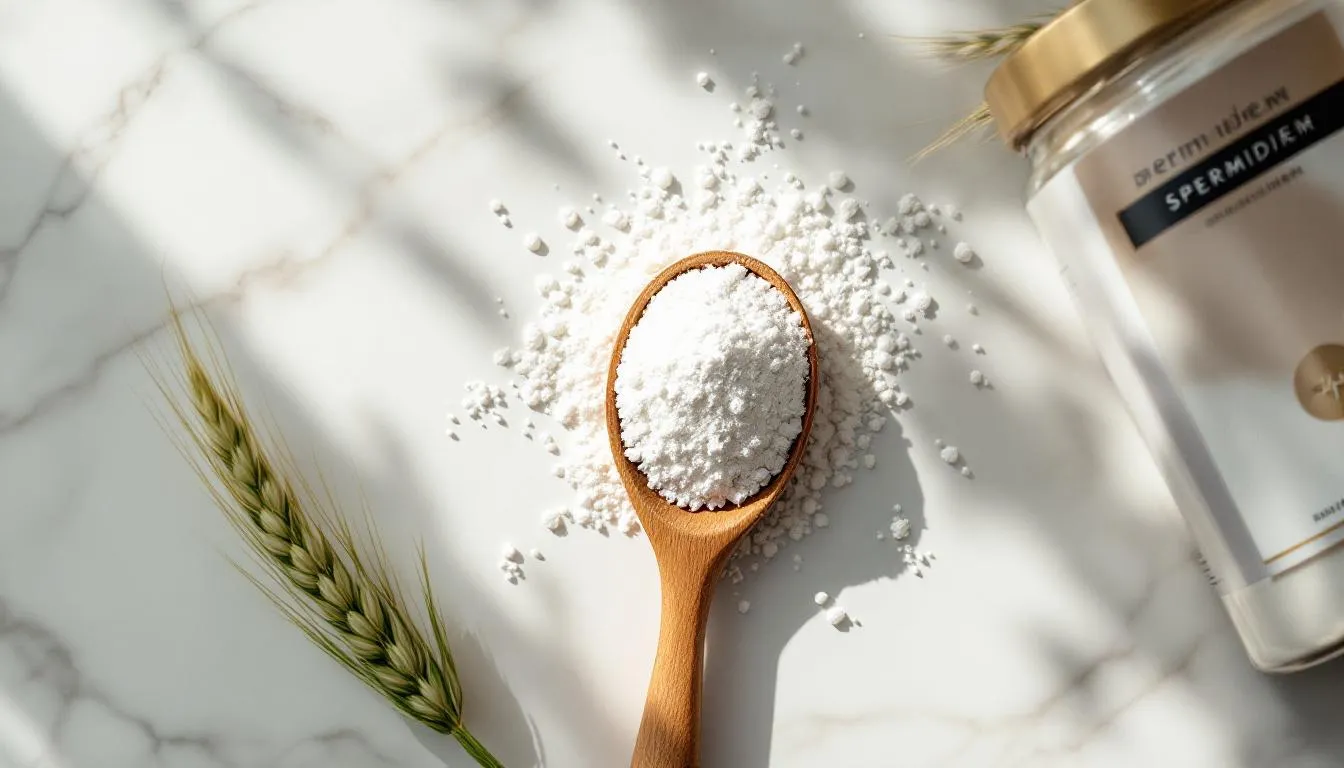
Spermidine powder is simply the compound in loose, dissolvable form rather than pre-packed into capsules. You mix it into water, a smoothie, or any food or drink that isn't hot. The active molecule is identical to what's in capsules. The difference is purely practical.
WinAging tracks the research across all major longevity compounds. Spermidine consistently ranks among the most promising for natural autophagy induction, especially for people who don't do extended fasting.
How spermidine works
The mechanism is well understood, and it's different from most longevity supplements.
Spermidine inhibits an enzyme called EP300, which normally acts as a brake on autophagy. When EP300 is inhibited, cells shift into cleanup mode. Damaged proteins get broken down and recycled. Dysfunctional mitochondria get cleared. This is exactly what happens during extended fasting, which is why spermidine is called a caloric restriction mimetic. You get some of the cellular benefits of fasting without skipping meals.
But there's more to it than autophagy.
Spermidine supports a process called eIF5A hypusination. The protein eIF5A needs spermidine to become activated, and activated eIF5A is required for the full effects of autophagy induction. This makes spermidine mechanistically connected to rapamycin's longevity effects. A 2024 study confirmed that rapamycin-induced longevity depends on downstream spermidine synthesis. Without sufficient spermidine, rapamycin's effects are blunted. They need each other.
Other mechanisms worth knowing:
Spermidine reduces NF-κB activity, one of the primary drivers of chronic inflammation. It modulates the acetylation state of over 100 proteins involved in cellular aging. Some researchers describe this as a partial epigenetic reset. In animal studies, it activates the SIRT1/PGC-1α pathway, which supports mitochondrial biogenesis, and it engages the AMPK-FOXO3a pathway to protect skeletal muscle from age-related atrophy.
None of this requires fasting. None of it requires eating specific foods. A daily supplement dose can activate these same pathways.
For longevity compounds that work through completely different mechanisms, read about why some people stop taking NMN and what they switch to instead. Or explore WinAging's longevity tools for a starting point on building your stack.
What the research actually shows
Let's be direct. The human evidence on spermidine is promising but still early. Most of the strongest data comes from animal studies. Clinical trial results in humans are encouraging, not yet conclusive.
Animal studies: Consistent and compelling. Spermidine extends lifespan in yeast, nematodes, fruit flies, and mice. In aged mice, dietary spermidine attenuated cardiac dysfunction, preserved telomere length, and reduced markers of systemic inflammation. The effect sizes were meaningful across multiple independent research groups.
SmartAge trial: The most cited human study. A 12-month randomized, double-blind, placebo-controlled trial enrolled 85 adults aged 60-90 with subjective cognitive decline. They received 0.9 mg/day of spermidine from wheat germ extract. The primary memory outcome didn't reach statistical significance, but exploratory analyses found benefit on verbal memory and inflammation markers. A follow-up at 3.3 mg/day showed significantly better MMSE scores. The lesson: dose matters.
High-dose pharmacokinetics (2023): This one surprised the field. Twelve healthy adults took 15 mg/day for five days. Plasma spermidine didn't rise. What rose was spermine, the downstream metabolite. Spermidine appears to act partly as a prodrug, converting to spermine in the gut before entering systemic circulation. It doesn't invalidate the supplement. But it means plasma spermidine isn't the right biomarker to track for efficacy.
40 mg/day safety study (2024): Researchers gave older men 40 mg/day, far above any commercial dose. No significant adverse events. Lipids, liver enzymes, blood pressure, and blood markers were all stable. The safety profile looks solid even at high doses.
POLYCAD trial (ongoing): A Danish randomized trial using 24 mg/day in elderly cardiovascular patients, measuring cardiac remodeling, muscle mass, and inflammation. This could become the landmark human trial the field has been waiting for.
Hair growth data: A randomized, double-blind trial found a spermidine-based supplement significantly increased the percentage of hair follicles in the growth phase after three months. If the skin and hair angle interests you, our guide on spermidine skincare covers this in depth.
Epidemiological data: Studies tracking dietary spermidine intake against mortality outcomes are some of the most compelling. Higher dietary intake is consistently associated with reduced all-cause mortality, lower cardiovascular mortality, and reduced neurodegeneration rates. This isn't proof of causation, but the signal is consistent across multiple population studies.
Spermidine powder vs. capsules vs. tablets
The active compound is identical across all forms. Spermidine is spermidine. But the practical differences are real.
Why some people prefer powder:
You already have a morning routine. Coffee, maybe a protein shake or smoothie. Adding a scoop of spermidine powder takes seconds and zero extra pills. If you want to adjust your dose, you can do it precisely without splitting capsules.
Cost is another factor. Powder forms, especially synthetic spermidine trihydrochloride (3HCl), often cost significantly less per milligram than capsule equivalents. If you're targeting higher doses, the savings add up fast.
Some users also prefer powder to avoid capsule fillers and binders. This matters more for synthetic forms than for whole-food-derived powders like wheat germ extract, which tend to use minimal excipients regardless.
Why some people prefer capsules:
Travel. Capsules win here, no measuring, no spills, no worrying about humidity. You take the capsule and you're done.
Taste is another consideration. Wheat germ extract has a mild, earthy flavor. Most people don't mind it in a smoothie, but if you're mixing into plain water, you'll notice it. Synthetic 3HCl powder is more neutral.
Capsules also provide better protection during storage. Powder is more sensitive to humidity and needs to be kept sealed, in a cool dry place, and used within the recommended window after opening.
Liposomal forms: Worth mentioning. Liposomal spermidine uses phospholipid encapsulation to protect the compound through the GI tract. Given the 2023 pharmacokinetics finding that spermidine converts to spermine anyway, it's unclear whether liposomal delivery provides a meaningful absorption advantage. But some companies are betting on it.
For a detailed breakdown of the most studied spermidine supplement, see our Primeadine review.
Dosage: how much spermidine powder to take
This is where it gets complicated, because there's no agreed-upon optimal dose. Research has used everything from 0.9 mg/day to 40 mg/day. Commercial products range from 1 mg per serving to 25 mg. The field hasn't converged on a number yet.
What we know from research:
The SmartAge trial found dose-dependent effects on cognition between 0.9 and 3.3 mg/day. Epidemiological data shows benefits at typical dietary intake levels around 2-4 mg/day. The POLYCAD trial uses 24 mg/day. The safety study confirmed tolerability up to 40 mg/day with no serious adverse events.
The European Food Safety Authority (EFSA) established a safe upper intake of 6 mg/day for food-derived spermidine. This doesn't mean higher doses are unsafe. It means food-derived forms haven't been rigorously studied above that threshold in regulatory safety assessments.
A practical dosing framework:
For beginners, start low. One to two milligrams per day from a wheat germ extract product like Primeadine is a reasonable starting point. It matches the doses used in early human research, gives you time to assess tolerance, and roughly matches what you'd get from a spermidine-rich diet.
If you're comfortable and want to explore higher doses, synthetic spermidine trihydrochloride at 5-10 mg/day is where many serious longevity supplementers land. This delivers a meaningful dose above typical dietary intake without going into uncharted territory.
High-dose protocols at 20-40 mg/day are being studied but not yet established as optimal. The safety data looks good, but whether efficacy increases proportionally above 10 mg/day hasn't been confirmed. If you're considering this range, check your full stack with the supplement interaction checker first.
For a complete breakdown of dosing evidence, see how much spermidine per day.
How to take spermidine powder
The process is simple, but a few rules matter.
Temperature is critical. Never mix spermidine powder into anything hot. The compound degrades above 60°C (140°F). No hot coffee, no boiling water, no freshly heated oatmeal. Wait for things to cool first, or use cold liquids. This is the most common mistake people make when starting with powder.
How to mix it:
Add your dose to water, a smoothie, cold-press juice, yogurt, or any cool food or drink. The powder is fine and dissolves well in liquids. A blender or shaker bottle prevents clumping if you're mixing into plain water. Stirring works fine for smoothies and thicker drinks.
Wheat germ extract powder has a mild, earthy, slightly nutty flavor. Not unpleasant, but noticeable. Most people add it to smoothies or flavored drinks. Synthetic 3HCl powder is more neutral and easier to dissolve in plain water.
Timing:
Autophagy tends to peak overnight and in the early morning. Taking spermidine in the morning, with or just before breakfast, aligns with this natural rhythm. The spermidineLIFE brand recommends taking it with food, which may also slightly improve absorption since polyamines are partially fat-soluble.
Consistency matters more than perfect timing. If you'll remember it better by adding it to an afternoon shake, do that. The goal is daily supplementation, not a specific hour.
Food sources vs. spermidine supplements
You can get spermidine from food. In fact, higher dietary spermidine intake is exactly what the epidemiological research measures when it finds longevity benefits. So the real question is whether you can get enough from diet alone.
The answer depends on your goals.
Best food sources by concentration:
Wheat germ is the richest source at roughly 243 mg per kilogram, or about 1.2-1.5 mg per tablespoon. Natto (fermented soy) contains 65-340 mg/kg depending on fermentation. Aged cheeses provide 50-200 mg/kg. Shiitake and king trumpet mushrooms run 120-160 mg/kg. Soybeans, chicken liver, green peas, and lentils all contribute meaningful amounts.
A diet that regularly includes these foods can provide 2-4 mg/day without any supplementation. For much of the epidemiological benefit, this is probably enough. See our complete guide on spermidine-rich foods for how to eat for higher natural intake.
Why people supplement anyway:
Consistency is the first reason. Getting 3+ mg/day of spermidine from food requires actively eating the right things every single day. That's harder than taking a supplement.
Dose is the second reason. If you're targeting 10-25 mg/day as some trials use, food sources won't get you there. You'd need several tablespoons of wheat germ plus large portions of natto and mushrooms daily.
The third reason is standardization. A supplement tells you exactly how much spermidine per dose. Food sources vary with freshness, preparation method, and fermentation degree.
This is also where wheat germ extract supplements offer something synthetic forms don't: cofactors. Natural wheat germ extract contains not just spermidine but spermine, putrescine, zinc, and selenium, which may work synergistically. Whether this matrix meaningfully outperforms the higher doses achievable from cheaper synthetic forms is still debated.
Best spermidine powder products
Most spermidine supplements come in capsule form. Genuine powder products are rarer. Here's what's available and worth considering.
Primeadine Original Powder (Oxford Healthspan)
The gold standard for food-derived spermidine powder. Primeadine uses concentrated, defatted Japanese wheat germ extract standardized to 1 mg spermidine per serving. The 3-month powder supply delivers the same dose as the capsule version at similar pricing, around $80 per month.
What sets Primeadine apart is provenance. The product was co-developed with Dr. Frank Madeo, the Austrian scientist behind much of the foundational spermidine-longevity research. The wheat germ extract used in SmartAge trial formulations comes from this supply chain. When you take Primeadine, you're taking something close to what was used in the human studies.
The powder mixes easily, has a mild wheat germ flavor, and is gluten-tested. A fully gluten-free version called Primeadine GF uses rice germ extract and suits people with celiac disease. See the full Primeadine review for more detail on this product.
spermidineLIFE (Austria)
The most researched brand overall, used in the SmartAge trial. Primarily available in capsules. The underlying wheat germ extract comes in around 1-1.2 mg spermidine per serving. Clean formulation, well-documented safety record. On WinAging, we track the research behind each of these brands as new studies emerge.
Synthetic spermidine trihydrochloride (3HCl)
If you want a higher dose at lower cost per milligram, synthetic 3HCl is the option. Companies like Double Wood offer capsule versions at 10 mg per serving. Some bulk supplement suppliers also sell raw 3HCl powder for those who want precise dosing at scale.
Purity is high at 98-99%, it's water-soluble, and it's naturally gluten-free. The tradeoff is you're getting only the isolated compound without the cofactor matrix of wheat germ extract. Whether that matters for real-world efficacy is genuinely unknown.
AgeMate Daily Longevity Blend
Not a dedicated spermidine product, but worth mentioning because it's a powder. It combines spermidine with NMN, resveratrol, and other longevity compounds in a single morning drink. The spermidine dose is low by clinical standards. If the all-in-one convenience appeals, it's a starting point, though you'll likely want to supplement specific compounds separately for meaningful doses. Read more on how NMN and these related compounds compare in our guide on NAD vs NMN.
Stacking spermidine with other longevity compounds
Spermidine fits naturally into a longevity stack. Its autophagy-inducing mechanism is distinct from most other longevity supplements, which means you're adding something genuinely new rather than overlapping with what you're already taking.
Spermidine and NMN/NR:
NMN and NR boost NAD+, which activates sirtuins like SIRT1 and SIRT3. Spermidine induces autophagy through EP300 inhibition. Different pathways, different targets, additive effect. The combination is common in serious longevity protocols.
Spermidine and resveratrol:
Resveratrol activates SIRT1 through a route that complements NAD+ precursors. Adding spermidine gives you another layer through the autophagy pathway. Both are caloric restriction mimetics, replicating some effects of fasting. For the debate on which to prioritize, see resveratrol or NMN: if you had to choose one.
Spermidine and rapamycin:
The most interesting combination from a mechanistic standpoint. Rapamycin inhibits mTOR, which triggers endogenous spermidine synthesis. A 2024 paper confirmed that rapamycin's longevity effects require this downstream spermidine production. Supplementing with spermidine on non-rapamycin days may potentiate the effect. This is an emerging area, but the mechanism is compelling.
Spermidine and fisetin or quercetin:
Senolytics clear senescent cells. They don't do much for the cells that remain. Spermidine's autophagy induction helps those remaining cells maintain quality and function. The combination is conceptually elegant: senolytics handle the worst offenders, spermidine keeps everything else running clean.
Spermidine and urolithin A:
Both are autophagy and mitophagy inducers, but through different pathways. Urolithin A focuses specifically on mitophagy, the removal of damaged mitochondria. Spermidine works more broadly. Together they cover more ground with no known interaction concerns.
Stacking spermidine with glycine:
Glycine supports cellular health through different mechanisms, including collagen synthesis, methylation support, and sleep quality. It complements spermidine well without any overlap. See glycine dosage for anti-aging for more on that compound.
Most researchers and serious supplementers take spermidine in the morning alongside NMN, resveratrol, and other morning compounds. Morning aligns with post-overnight autophagy rhythms, and grouping supplements improves adherence. Check your full stack for interactions at the supplement interaction checker.
For how spermidine fits into broader longevity protocols, see our guides on spermidine benefits for women and spermidine benefits for men.
Not sure how to structure a complete longevity protocol around spermidine and other compounds? WinAging's AI protocol builder creates a personalized stack based on your age, goals, and current supplements.
Side effects and safety profile
Spermidine has a genuinely good safety record. Multiple human studies at doses from 1 mg to 40 mg/day have found no significant adverse events. This isn't a compound with a long list of cautions.
What to expect:
Most people experience nothing at normal doses. At higher doses above 10 mg/day, some users report mild GI discomfort, particularly on an empty stomach. This is more common with synthetic 3HCl powder than with food-derived wheat germ extract. Taking it with food typically resolves this.
Wheat germ-derived products carry a gluten concern for celiacs and severely gluten-sensitive individuals. Primeadine Original is wheat-derived and tested to low gluten levels, but Primeadine GF uses rice germ and is the safer option for celiac disease. Synthetic 3HCl is inherently gluten-free.
The cancer question:
This requires honest acknowledgment. Polyamines, including spermidine, are found at elevated levels in rapidly dividing cells, including some cancer cells. Autophagy's relationship with cancer is complex. For healthy cells, autophagy is protective, clearing damaged cells before they accumulate mutations. But some cancer cells under metabolic stress can use autophagy as a survival mechanism.
The current scientific consensus is that spermidine supplementation likely has protective effects in healthy people. But if you're actively being treated for cancer, talk to your oncologist before adding any autophagy-inducing supplement.
Drug interactions:
There are no well-documented drug interactions with spermidine specifically. Because it modulates autophagy pathways, there's theoretical interaction potential with chemotherapy agents. For most people on standard medications, this isn't a practical concern. Worth mentioning to your doctor if you're on complex medication regimens.
Who should take spermidine powder
Good candidates:
Adults over 40 who want to support healthy cellular aging. Spermidine levels decline with age, and the research on dietary intake and longevity is some of the most consistent in the supplement field.
People who can't or don't want to do extended fasting. Autophagy induction through fasting is powerful, but 24-48 hour fasts aren't accessible or desirable for everyone. Spermidine offers some of the same cellular cleanup benefits without skipping multiple meals.
Those with family history of cardiovascular disease or cognitive decline. The human evidence is most developed in these areas, with the strongest associations against cardiac and neurodegenerative mortality.
Anyone already on an NMN, resveratrol, or rapamycin protocol. Spermidine adds a complementary mechanism without interfering with any of those compounds.
Who should wait or skip:
Pregnant and breastfeeding women. No safety data in pregnancy. Given spermidine's effects on cellular proliferation pathways, it's not worth the risk without evidence.
Children and teenagers. Not studied in this population, and not needed. Endogenous spermidine production is naturally high in younger people.
Active cancer patients. The relationship between autophagy induction and cancer treatment outcomes is context-dependent. Consult your oncologist.
People with celiac disease using wheat germ extract forms. Use the rice germ version or switch to synthetic 3HCl.
For a concrete sense of where you stand biologically before starting, use the biological age calculator to establish a baseline.
For a broader look at how spermidine fits into the longevity picture for younger adults, see our guide on spermidine for youth.
Frequently asked questions
What does spermidine powder taste like?
Wheat germ extract powder has a mild, slightly earthy, nutty flavor. Subtle enough that most people don't notice it in a smoothie or flavored drink. Synthetic spermidine trihydrochloride powder is more neutral. If taste is a concern, start with the synthetic form or mix the wheat germ version into a strongly flavored shake.
Does spermidine powder raise blood levels of spermidine?
Interestingly, no. A 2023 pharmacokinetics study found that 15 mg/day did not raise plasma spermidine. What rose instead was spermine, the downstream metabolite. Spermidine appears to act as a prodrug, converted in the gut before entering systemic circulation. This means plasma spermidine isn't the right biomarker to track. The cellular effects are real, but the mechanism is more complex than simple blood level elevation.
Is spermidine powder better than capsules?
Not inherently better, just different. Powder is easier to dose flexibly, integrates well into a morning smoothie routine, and is often more cost-effective per milligram at higher doses. Capsules are more convenient for travel and daily precision dosing. The active compound is the same. Choose the form you'll actually take consistently. That's the only form that works.
Can I take spermidine powder with coffee?
Not if your coffee is hot. Spermidine degrades above 60°C (140°F). You can add it to cold brew, iced coffee, or let your hot coffee cool to room temperature first. If your morning starts with a hot drink, just add the powder to something cold alongside it.
How long does it take for spermidine to work?
The SmartAge trial ran for 12 months. The hair growth study found changes at 3 months. Autophagy induction is a cellular process that works continuously, but observable effects on biomarkers or cognitive markers likely take weeks to months of consistent supplementation. Don't expect to feel something on day one.
What's the difference between spermidine powder and spermidine trihydrochloride?
Spermidine trihydrochloride (3HCl) is a salt form of spermidine, highly stable and water-soluble, with 98-99% purity. Most synthetic supplements use this form. Whole-food powders like Primeadine use wheat germ extract at around 1 mg/gram, with natural cofactors included. Both deliver spermidine. The 3HCl form offers higher doses at lower cost per milligram. The wheat germ form offers the natural matrix of supporting polyamines and nutrients.
Is the spermidine in supplements the same as from food?
Yes. The molecule is identical regardless of source. Wheat germ, natto, or a synthetic supplier all deliver the same spermidine. The difference is concentration and context. Food sources come with fiber, other polyamines (spermine, putrescine), and various nutrients. Supplements give you the isolated compound, or in the case of wheat germ extract, the compound with its natural cofactors. See our guide on spermidine-rich foods for how to optimize dietary intake alongside supplementation.
Can younger people benefit from spermidine?
The longevity research focuses on adults over 40, where age-related decline in endogenous spermidine becomes most relevant. Younger adults have naturally higher levels. There's no evidence of harm for people in their 20s-30s, but the benefit-to-cost ratio is less compelling. The compound becomes more valuable as endogenous production declines with age. For a nuanced look at this, see spermidine for youth.
What's the cost difference between powder and capsules?
It varies widely by brand and dose. Primeadine capsules and powder cost roughly the same at around $80/month for 1 mg/day. But synthetic 3HCl in capsule form (like Double Wood at 10 mg/serving) runs closer to $10-15/month for a 10 mg/day dose. Raw 3HCl powder from bulk suppliers can be even cheaper per milligram. The whole-food forms cost more per milligram but include the natural cofactor matrix. Which is worth more depends on your dosing goals.
Related guides
- Primeadine review: is it the best spermidine supplement?
- Spermidine-rich foods: how to eat for autophagy
- How much spermidine per day: dosage guide
- Spermidine benefits for women: what the research shows
- Supplement interaction checker
Sources
- SmartAge trial: spermidine wheat germ supplementation for cognition - JAMA Network Open
- High-dose spermidine pharmacokinetics study - PMC
- Spermidine induces autophagy by inhibiting EP300 acetyltransferase - Nature Cell Death and Differentiation
Your cells clean themselves. That's the whole point of autophagy. And they do it better when they have enough spermidine. Powder makes daily supplementation simple, flexible, and cost-effective, especially if you already have a morning shake routine. Start low, stay consistent, and give it months, not days, to see what it does. If you want a personalized longevity protocol built around spermidine and your other goals, WinAging's AI protocol builder creates a custom stack based on your age, health profile, and experience level. Or start with the free longevity tools to see where you stand today.